Media Angles
Part of PR image and document packs
Choosing images with clear usage permission
Check who can authorise a PR image, what its licence permits and whether a journalist may publish the file before adding it to a media pack.
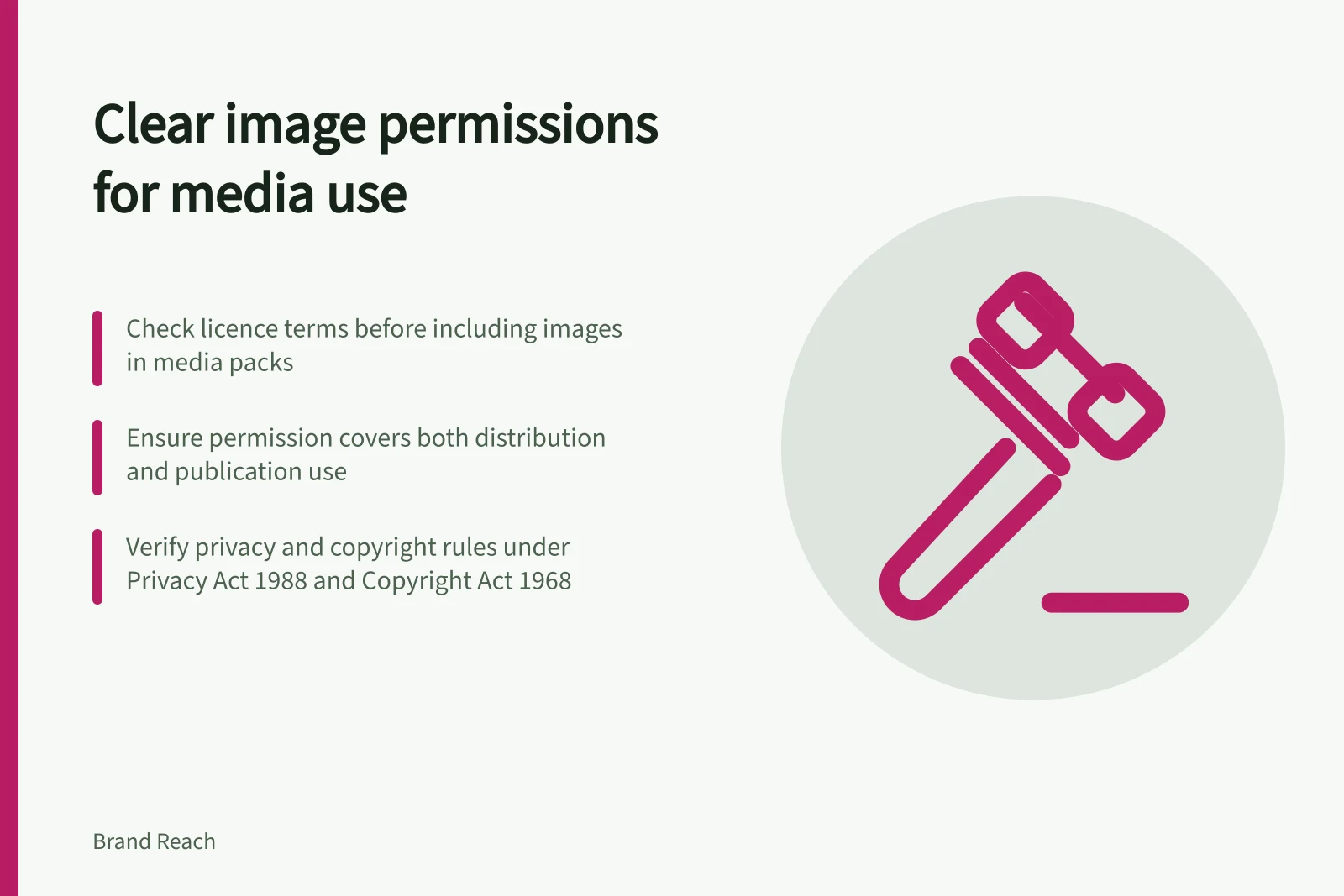
Before an image goes into a media pack, identify who can authorise its use and whether permission covers both your distribution of the file and the publication's intended use. Credit alone does not grant permission. If the terms cannot be found or understood, hold the image while you check, or choose another.
Trace the image and its permission
Find the original file and its history. Who made it? Was it commissioned, supplied by an agency or partner, or obtained from a stock library? Locate the agreement or licence for that image. Its appearance on a public webpage does not, by itself, show that you can copy it into a media pack.
Check the permitted uses, channels, territory, duration, changes and required credit. Permission to show a photograph on your own site may not extend to giving it to newsrooms for publication. Keep the applicable wording with the asset rather than marking the file simply 'approved'.
Read the exact licence
The Copyright Act 1968 is the Australian statute named for copyright. Moral rights arise under the Act and are distinct from copyright: authors have rights of attribution, against false attribution and integrity of authorship. Credit does not replace permission to copy and share an image.
Check the licence and version attached to the particular image. For example, IP Australia says most of its website content can be copied and shared in any medium or format, and adapted for any purpose, under its Creative Commons Attribution 4.0 licence. Its conditions require proper attribution, an indication of changes and a link to the licence.
That notice does not cover every asset on the site. It excludes the corporate logo, photographs of staff and premises, and third-party content; it also says direct copies of pages cannot be displayed on another website. Check the notice for the exact image and retain the licence or written permission with the asset record.
Australian legal frameworks governing image use
- Privacy protection
- Privacy Act 1988 (Australia)
- Government guidance on images
- Style Manual – Images section
Check the people and details shown
Under the Privacy Act 1988, photos and videos are personal information if a person's identity is clear or could reasonably be worked out; privacy rights depend on the situation. The Act does not apply when a photo or video is taken by someone acting in a personal capacity, and state or territory laws may restrict photography of private activities without consent.
Ask how the image was obtained, what the person was told and whether the proposed reuse is appropriate. Take particular care with children, private settings and sensitive circumstances. Privacy considerations do not establish that you have copyright permission to copy and distribute the image.
Inspect the scene for information that should not be released, such as a customer name on a screen or a document on a desk. If a crop would solve a problem, first check that the licence permits it and that the result would remain an accurate representation.
Record a decision someone else can use
Keep the file identifier, creator or supplier, rights holder, licence wording or written permission, authorised uses, required credit, restrictions, expiry if any, and reviewer together. Retain the licence or written permission with the asset record, rather than relying on a label such as 'approved'.
State whether redistribution to journalists and their likely publication use are covered. Mark the image use, clarify or replace. A relevant photograph with known terms is more useful than one whose use must be guessed.