Media Angles
Part of Finding a credible media angle
Checking whether a story fits the publication's audience
Assess a media angle against a publication’s readers, editorial formats and contributor rules before deciding whether to offer it.
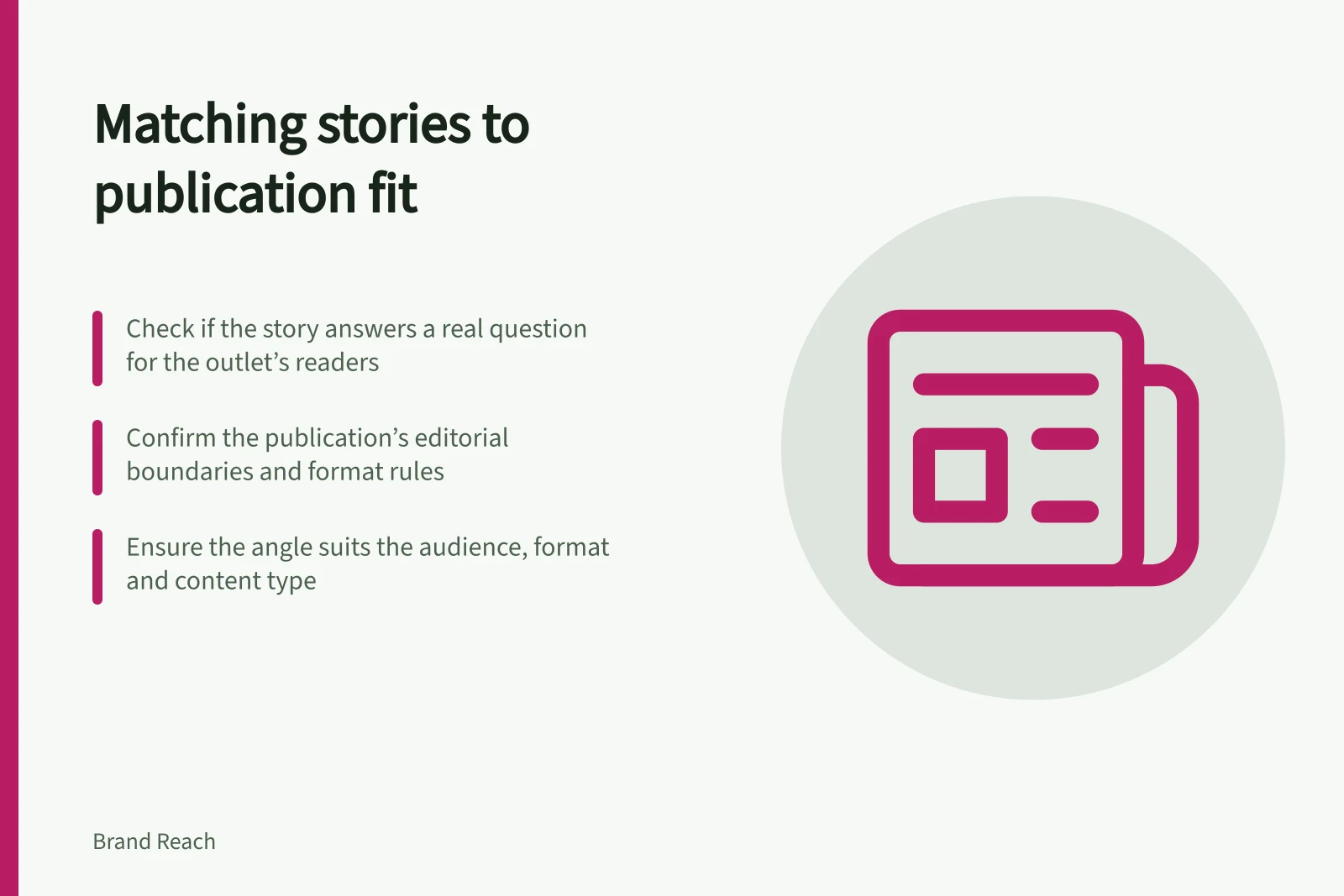
A story fits a publication when its readers have a reason to use the information and the outlet has a suitable way to present it. Test the reader’s likely question, the explanation the story needs and the publication’s stated editorial boundaries before offering the angle. A shared topic alone does not establish a fit.
This is a publication-level decision. Choosing an individual journalist and checking their recent work comes later.
Describe the readers the publication serves
Start with the outlet’s own description of its audience and subject areas, where available. Then read the section where the story might appear.
Ask who it serves: residents of a place, practitioners in an industry, consumers making choices or a broad public audience.
A national publication does not need every Australian story. A specialist outlet does not need every item in its sector.
Turn the angle into a reader question. A regional service change might answer “How will this affect people using the service here?” A trade finding might answer “What can practitioners learn from this pattern?” If the story cannot answer a question for the publication’s readers, its reach or reputation does not make it a good fit.
Publication types and their audience focus
- National publicationBroad public audience; requires wider relevance beyond local impact
- Regional publicationLocal residents or community users affected by local changes
- Trade or industry publicationPractitioners in a sector seeking operational insights or trends
- Specialist media outletNiche audience with deep interest in specific topics (e.g., superannuation policy, GST reforms)
Check the outlet’s editorial boundaries
Look for its current contributor or submission guidance. Check what it accepts, who may contribute and what it excludes. News, opinion, analysis and commercial content may have different routes or requirements. A data finding that needs careful definitions may suit a fuller analysis better than a short notice.
Match the angle to the format
Answer four questions:
- Reader:Who in this publication’s audience would use the information?
- Question:What would the story help that reader understand?
- Format:Which editorial format could explain the point and its main limit?
- Boundary:Do the publication’s stated rules permit this kind of material or contributor?
Consider a hypothetical business dataset about appointments in one regional town. A local outlet may have readers affected by a service change; an industry title may care about an operating question behind the pattern. A national outlet would need a separate reason its wider audience should care. The records do not become national evidence because the publication is national.
How to assess if a story fits a publication’s audience
- Identify the target readerResidents, practitioners, consumers or broad public
- Formulate the reader’s likely questionE.g., 'How will this affect people using the service here?'
- Match the angle to the formatNews, opinion, analysis, or data-driven feature based on depth and scope
- Verify editorial boundariesCheck submission guidelines for exclusions and contributor eligibility
- Decide before outreachMark as suitable, needs narrower angle, or unsuitable
Decide before outreach
Mark the publication as suitable to consider, needs a narrower angle or unsuitable on present evidence. Record the reader question and any editorial rule behind the decision. If the story suits the readers but needs more explanation than the format allows, revise the angle or consider another format. If the publication excludes the material, respect that boundary.