Original Research
Part of Finding a credible media angle
Turning original business data into a useful finding
Find a defensible observation in business records by defining the population, measure, comparison and limits before writing a headline.
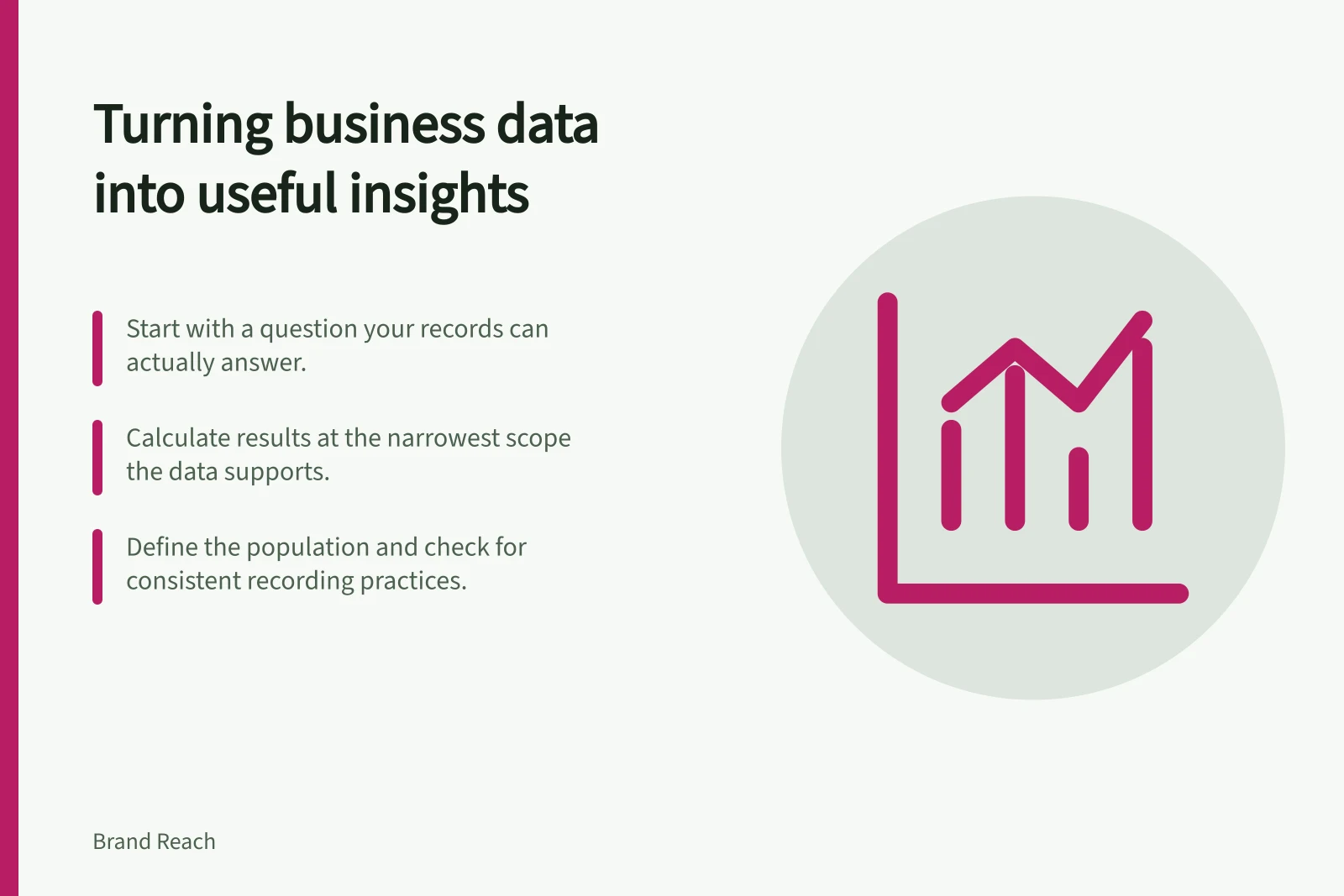
Start with a question the business records can answer. Calculate the result at the narrowest scope those records support. A useful finding states what was measured, for whom and when, and why it might help someone outside the business. Customer records alone cannot establish what all Australians do or want.
Find a question the records can answer
Inventory the fields before searching for a headline. Does each row represent an order, enquiry, account or person? Can one person create several rows? Which dates mark the event? Have definitions or recording practices changed? These answers determine what can be counted.
Write a reader question that fits the records. “Did requests for a particular service change among our Australian customers?” is answerable only if the business can define requests, identify those customers and compare periods consistently. “What do Australians want?” is a much broader question.
Records may cover every transaction the business captured and still tell little about the wider market. The Australian Bureau of Statistics distinguishes a count of every unit in a defined population from a sample. It also explains why estimates for a wider population are difficult to infer from a non-random sample. Define the population your records cover before using terms such as customers, buyers or Australians.
Build a fair comparison
Choose a measure and denominator that match the question. A rise in raw enquiries could reflect more customers, a longer period or a recording change. A rate per eligible customer may answer a different question, but only if eligibility is reliably recorded. Say whether you are comparing counts, shares, rates or amounts.
Check that periods have comparable lengths and the same inclusion rules. Look for duplicate events, missing dates, changed categories, new branches and campaigns that could affect the pattern. Record differences that matter to the comparison.
Review the relevant series and sensible alternative groupings, rather than selecting only the most dramatic result. A movement in a small subgroup may give a misleading impression beside the overall pattern. ABS guidance identifies coverage, non-response and response errors as possible non-sampling problems in collected data. For business records, the practical question is whether events were captured and processed consistently enough for the proposed comparison.
Draft the finding at its supported size
A working finding should contain the group, measure, comparison and period. For example, a hypothetical service business might eventually report: “Recorded requests for service A made up a larger share of our enquiries in the later period.” That sentence still needs actual counts, definitions and a checked calculation before use. It does not establish why the share changed or whether the pattern occurred elsewhere.
Ask what an outside reader learns. An observation may help a trade audience examine demand within a service category. If it only restates the company’s sales performance, a company update may be more useful. Owning data does not by itself make its results newsworthy.
Decide whether to use, narrow or discard it
Give the draft finding to someone who did not run the calculation. Can they identify the denominator, reproduce the result and name a plausible alternative explanation? If a reasonable definition changes the result materially, use the more defensible wording or leave the finding out.
Keep a record of the source fields, extraction date, filters, calculation and limitations. Make those details available in an appropriate form if the finding is used. If the records cannot answer the reader’s question, that is a reason to narrow the question or improve future collection, rather than strengthen the headline.