Journalist Research
Part of Expert commentary for journalists
Matching an expert to the question being asked
Choose a spokesperson by the exact question, their direct knowledge, evidence access, interests and availability.
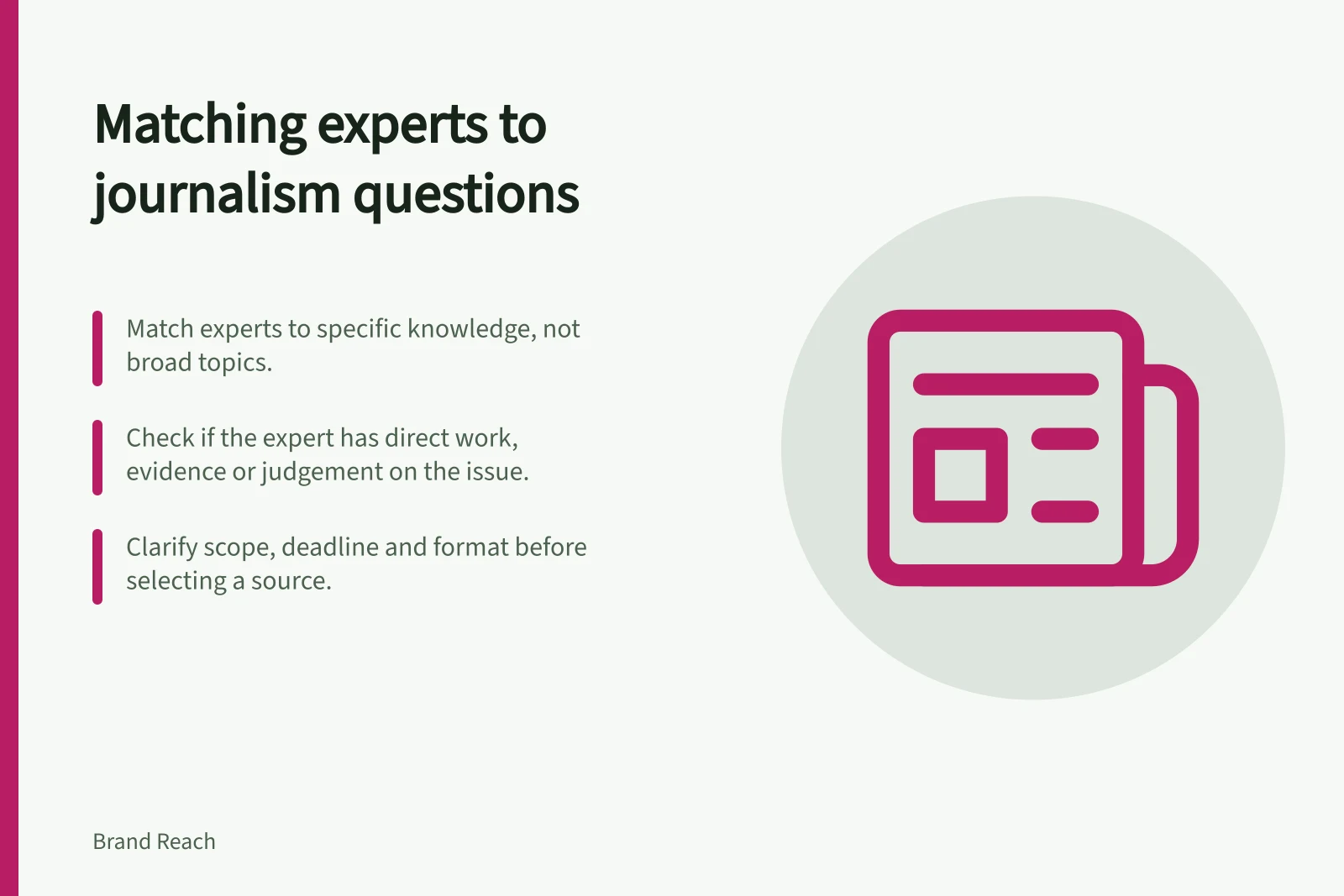
Match an expert to the knowledge the journalist needs, not to the broad topic in their biography. The useful question is: what can this person explain from direct work, reliable evidence or a clearly identified professional judgement?
Define the job before choosing a name
Turn the request into a specific task.
A journalist asking why a published figure changed may need someone who understands the dataset and its definitions. A question about how a service works may call for the person who runs it. A question about likely future effects calls for someone able to explain assumptions and uncertainty. These people might work in the same organisation, but their answers are not interchangeable.
Clarify the question, deadline, format and geographic scope. Ask whether the reporter wants background explanation, an attributable comment or an interview. You need not demand a complete list of questions; knowing the general subject is enough to test whether the proposed expert is suitable.
How to Match an Expert to a Journalist’s Question
- Define the taskTurn the request into a specific task – e.g., explain dataset definitions, service operations, or future projections.
- Clarify scopeConfirm deadline, format, geographic focus and whether background, comment or interview is needed.
- Identify direct knowledgeMatch the expert to first-hand experience, not just title or broad role.
- Assess fit using criteriaUse the five-point fit check: relevant work, evidence access, scope, independence, availability.
- Communicate clearlySend a precise introduction explaining role, remit and limits of knowledge.
Check the basis for their authority
Use a short fit check:
- Relevant work:Has the person studied, designed, delivered or directly observed the matter being discussed?
- Evidence access:Can they identify the records, research or experience behind a factual claim?
- Scope:Does their knowledge cover the population, place and period in the question?
- Independence:Is there a financial, organisational or advocacy interest the journalist should know?
- Availability:Can they respond and clarify points before the deadline?
A title can help describe a person’s role; it does not answer these questions. A founder may be the right source for a company decision but an unsuitable source for an independent assessment of its market impact. Conversely, a technical employee may explain a process better than the most senior spokesperson.
Expert Fit Check: Key Criteria for Journalistic Accuracy
- Relevant workHas the person studied, designed, delivered or directly observed the matter being discussed?
- Evidence accessCan they identify the records, research or experience behind a factual claim?
- ScopeDoes their knowledge cover the population, place and period in the question?
- IndependenceIs there a financial, organisational or advocacy interest the journalist should know?
- AvailabilityCan they respond and clarify points before the deadline?
When a Title Isn't Enough: Founder vs. Technical Employee
- FounderMay be best for company decisions but unsuitable for independent market impact assessment.
- Technical employeeOften better at explaining processes than senior spokespersons.
Send a precise introduction
Describe the expert in terms of the task: their role, the work that gives them first-hand knowledge and the limit of their remit. If the answer depends on an unpublished internal dataset, say that it is company data and explain what can be shared for checking.
Disclose a relevant connection to the subject. A journalist can then decide how much weight to give the comment and whether another perspective is needed.
Do not promise that the expert can speak for a whole industry because they know one organisation well. Do not present an adjacent qualification as direct expertise.
If part of the question falls outside their remit, offer the part they can answer and name the boundary. Where nobody on the roster fits, decline the request promptly or suggest a more suitable independent source if you know one.
The match is complete when the journalist knows why this person can answer this particular question, what their answer will be based on and what they cannot establish.