Original Research
Part of Expert commentary for journalists
Separating expert knowledge from speculation
Learn to distinguish observations, evidence, interpretation and forecasts in expert commentary, and state the limits of each claim.
Expert knowledge has an identifiable basis and a defined reach. Speculation starts when a speaker moves beyond that basis without signalling the move. A useful media comment can include interpretation or a forecast, but readers should be able to tell it from an observed fact.
Label the type of claim
When reviewing a proposed answer, sort each substantive sentence into one of four groups:
Type / Question to ask
- Observation
- What did the expert directly see or measure?
- Established evidence
- Which accessible record or study supports it?
- Interpretation
- How did the expert reason from that evidence?
- Forecast
- Which assumptions must hold for it to happen?
The groups may sit in one paragraph, but they should not blur together. A person’s experience at one company can support an account of that company’s process. On its own, it cannot establish what every business in Australia does. A study may show that two things changed together without showing that one caused the other.
Distinguishing Expert Claims: Observations, Evidence, Interpretation and Forecasts
- Observation
- What did the expert directly see or measure?
- Established evidence
- Which accessible record or study supports it?
- Interpretation
- How did the expert reason from that evidence?
- Forecast
- Which assumptions must hold for it to happen?
Make the limit part of the answer
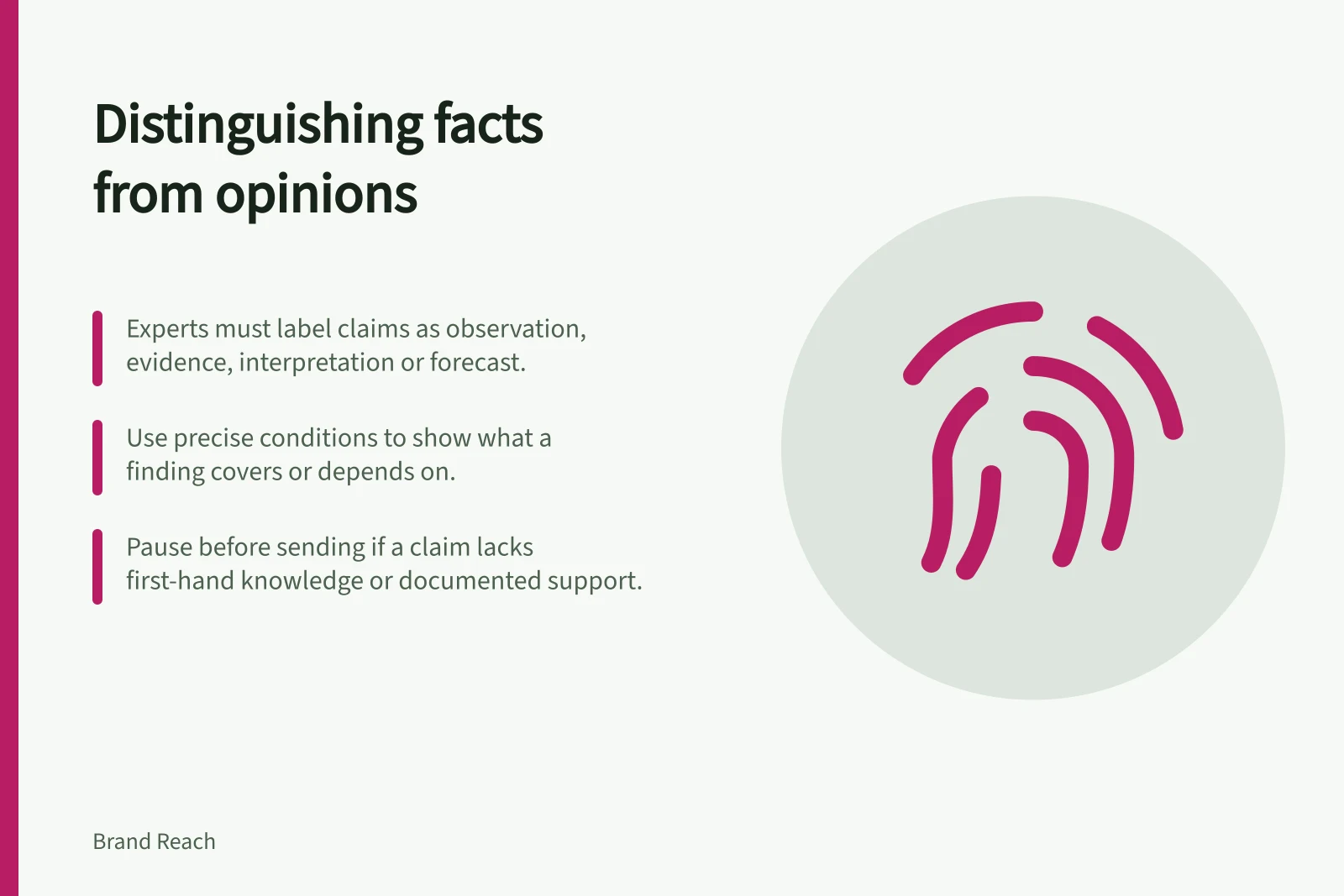
Replace certainty that the evidence cannot carry with a precise condition. State the population, period or setting covered by a finding. For a forecast, say what it depends on and which outcome remains uncertain. For a disputed issue, identify a credible alternative explanation rather than implying that disagreement has been settled by the expert’s title.
Vague hedges in every sentence are not the answer. “Possibly” and “perhaps” are poor substitutes for naming the actual unknown. If the expert has not seen the underlying figures, say they can explain the general mechanism but cannot verify the reported result. If they have reviewed a small internal sample, describe that sample instead of making a market-wide claim.
Key Principles for Responsible Expert Commentary in Australia
- Clarify forecast conditions
- Outline what assumptions must be true for a prediction to hold.
- Acknowledge alternatives
- Present credible alternative explanations for disputed issues instead of implying consensus.
Use a stop rule for unsupported claims
Pause before sending a comment if it asserts another organisation’s motives, predicts a definite outcome without a stated basis or describes an unverified report as fact. Ask whether the expert has first-hand knowledge, a document or a sound method. If not, narrow the sentence to what can be supported or remove it.
An expert can also decline a question. A clear answer such as “that is outside my work” protects the reader from a confident but weak claim. Where part of the question is answerable, respond to that part and leave the rest open for a better-qualified source.
Before release, have someone uninvolved in the draft underline every apparent fact and identify its basis. Review the remaining sentences for interpretation and prediction. The point is to make the expert’s reasoning useful without allowing their authority to stand in for evidence.
Stop Rule: Before Publishing Expert Commentary
- Does the claim rely on first-hand knowledge, a document or a sound method?If not, either narrow the claim or remove it.
- Can the expert decline the question?Use phrases like ‘that is outside my work’ to avoid overreaching.
- Have an independent reviewer check facts?Ask someone uninvolved to underline every apparent fact and identify its basis.