Pitching
Part of PR response and issue handling
Avoiding speculation in a public response
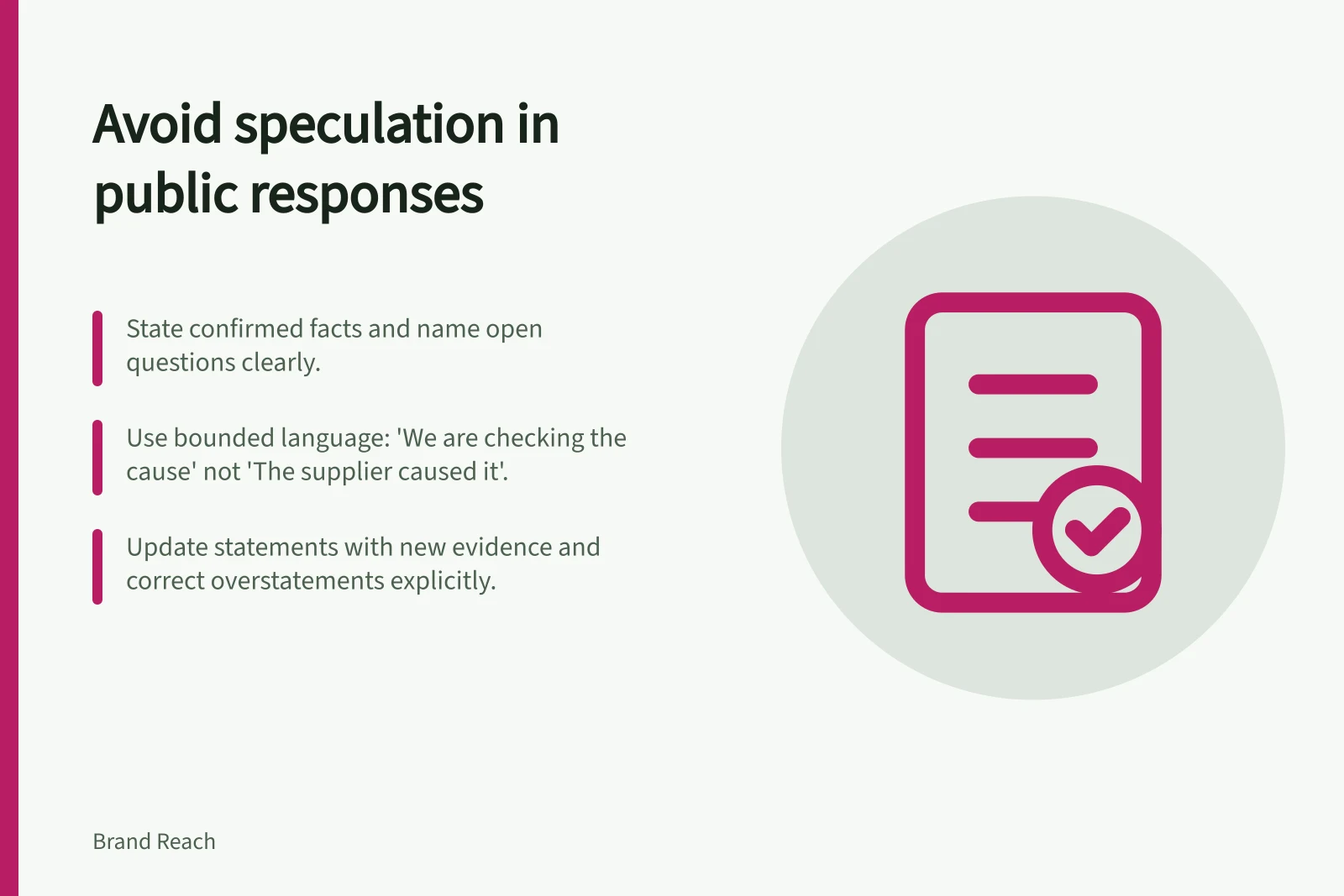
Identify unsupported claims about cause, scale and future outcomes, then state what is known and what remains open.
State what has been confirmed, name the question still open and avoid an explanation or prediction that lacks a basis. Precise uncertainty helps readers: “We are checking the cause” says more than a confident guess or a vague assurance.
Find claims that go beyond the record
Read each proposed sentence and ask what evidence establishes it. A record may show when an incident began without showing why. A customer report may identify a possible effect without showing how many people experienced it. A repair plan does not prove when normal service will resume.
Check claims about cause, scale, motives and future outcomes separately. Do not turn “we have found no further cases in the records checked so far” into “there are no further cases”. The second statement covers more than the check established.
Mark each substantive sentence as an observed fact, supported interpretation, plan or unresolved question. Keep that distinction visible in the wording. An interpretation should give its basis; a plan should not read like a completed outcome.
Replace guesses with bounded information
Give the verified part first, then its limit and the next check. These examples are hypothetical and would need their stated facts checked before use.
| Wording to question | Bounded alternative |
|---|---|
| “The supplier caused the fault.” | “The service fault began at the confirmed time. We are still checking its cause.” |
| “No one else was affected.” | “We have identified the confirmed affected group. We are checking whether other accounts were affected.” |
| “Service will return shortly.” | “We cannot yet confirm a restoration time. We will update the service notice when the repair team has one it can support.” |
| “The report is false.” | “We have checked the specific claim against the identified record. That record shows the stated result; we are checking the remaining points.” |
Use only an alternative that matches the actual record. If even the first sentence cannot be established, leave it out.
Before and after: Replacing speculative claims with bounded information
- Speculative wordingThe supplier caused the fault.
- Bounded alternativeThe service fault began at the confirmed time. We are still checking its cause.
- Speculative wordingNo one else was affected.
- Bounded alternativeWe have identified the confirmed affected group. We are checking whether other accounts were affected.
- Speculative wordingService will return shortly.
- Bounded alternativeWe cannot yet confirm a restoration time. We will update the service notice when the repair team has one it can support.
Keep limits where readers will see them
A qualification buried below an absolute headline may not repair its first impression. Read the headline, opening, prepared quotation, short post and customer notice on their own. If one says “all”, “none”, “caused” or “will” more strongly than the record supports, narrow the wording there.
Avoid generic caution that hides useful information. “We take this seriously” expresses a stance but does not explain who may be affected or what they should do. Give any confirmed practical action clearly even if the cause remains unknown.
Where a statement includes claims about a product or service, check that those claims and any prediction have reasonable grounds. The Australian Competition and Consumer Commission's guidance addresses business claims in that context; whether it applies to a particular response depends on the response and circumstances.
Key principles for responsible public communication in Australia
- Australian Competition and Consumer Commission (ACCC) guidanceApplies to business claims about products or services; requires reasonable grounds for predictions
- Press Council of Australia standardsEmphasise accuracy and transparency in public statements
- ABC News Ethics and Accuracy GuidelinesAdvocate for precise uncertainty over confident speculation
Update the account
Give each open question an owner and identify what evidence could resolve it. Offer an update time only when it can reasonably be met or revised. When a new fact is established, date the new statement and say whether it confirms, narrows or changes the earlier account.
If an earlier statement overstated certainty, correct it explicitly. Before release, ask whether someone reading only this response could mistake a possibility for a finding.