Pitching
Part of Digital PR campaign reviews
Reviewing why journalists declined a story
Use stated reasons for a declined PR story to check evidence, audience fit and timing while keeping guesses separate from replies.
Start with what the journalist actually said. Record an explicit reason as a stated reason; keep your own diagnosis separate. A decline can help improve a story, but silence or a brief 'not for us' cannot reveal the journalist's full reasoning.
Preserve the reply and its scope
Keep the pitch version, recipient, date and reply together. Note whether the journalist declined this angle, said the topic was outside their remit, identified a factual concern or asked not to receive further approaches. Those responses call for different actions.
A request to stop contact needs to be respected across the team. It is not material for a creative rewrite.
Paraphrase carefully if the review will circulate beyond the original sender. 'The sample does not support that headline' is a specific concern; labelling it 'disliked our data' changes the meaning. Where the wording is ambiguous, leave it ambiguous.
Check the concern against the material
An explicit reason should trigger a check, not an automatic concession or rebuttal. If the journalist questioned a figure, ask the research owner to repeat the calculation and inspect its denominator, dates and exclusions.
If the concern was audience fit, compare the story's scope with the publication's readership and format. If the topic had already been covered, check what the earlier article established before calling your version new.
| Illustrative response | Review task | Possible decision |
|---|---|---|
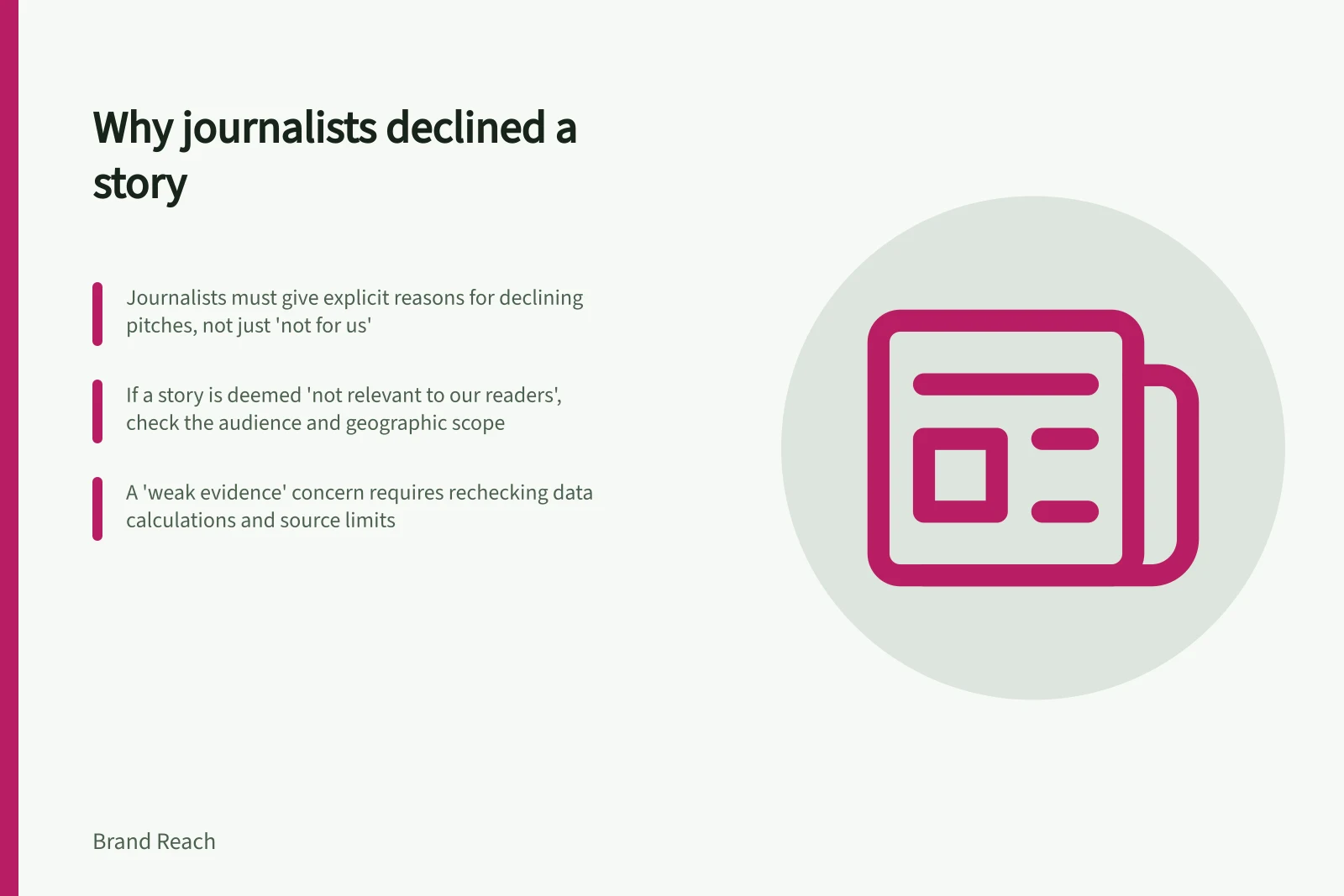
| ‘Not relevant to our readers’ | Recheck the reader question and geographic or professional scope | Narrow or change the outlet list |
| ‘The evidence is too thin’ | Inspect the claim, method and material limit | Strengthen evidence, narrow the claim or hold |
| ‘We have covered this’ | Compare the prior report with the proposed addition | Find a genuine update or stop |
| ‘Not now’ | Check whether the story depends on a real date or development | Wait for a relevant change |
These are examples of review paths, not records of actual replies. A journalist may offer no reason, and their editorial decision need not be debated.
Look for a pattern without erasing differences
Group stated reasons only after reading them individually. Several questions about the same missing definition may indicate a repairable evidence gap. Declines from outlets serving different audiences may have different causes.
Show the number of replies containing each stated reason and the number giving no reason. If percentages help, show their base; avoid implying that a small or incomplete set represents all recipients.
Choose an action the evidence supports. A confirmed error needs correction for people who received it, whether or not the story remains attractive. A weak audience match calls for a narrower distribution decision.
A sound finding declined by one editor may require no change. Close with the stated reason, the team's separately labelled interpretation and the next action. Do not press a journalist for a fuller explanation merely to complete an internal form.