Campaign Reviews
Digital PR campaign reviews
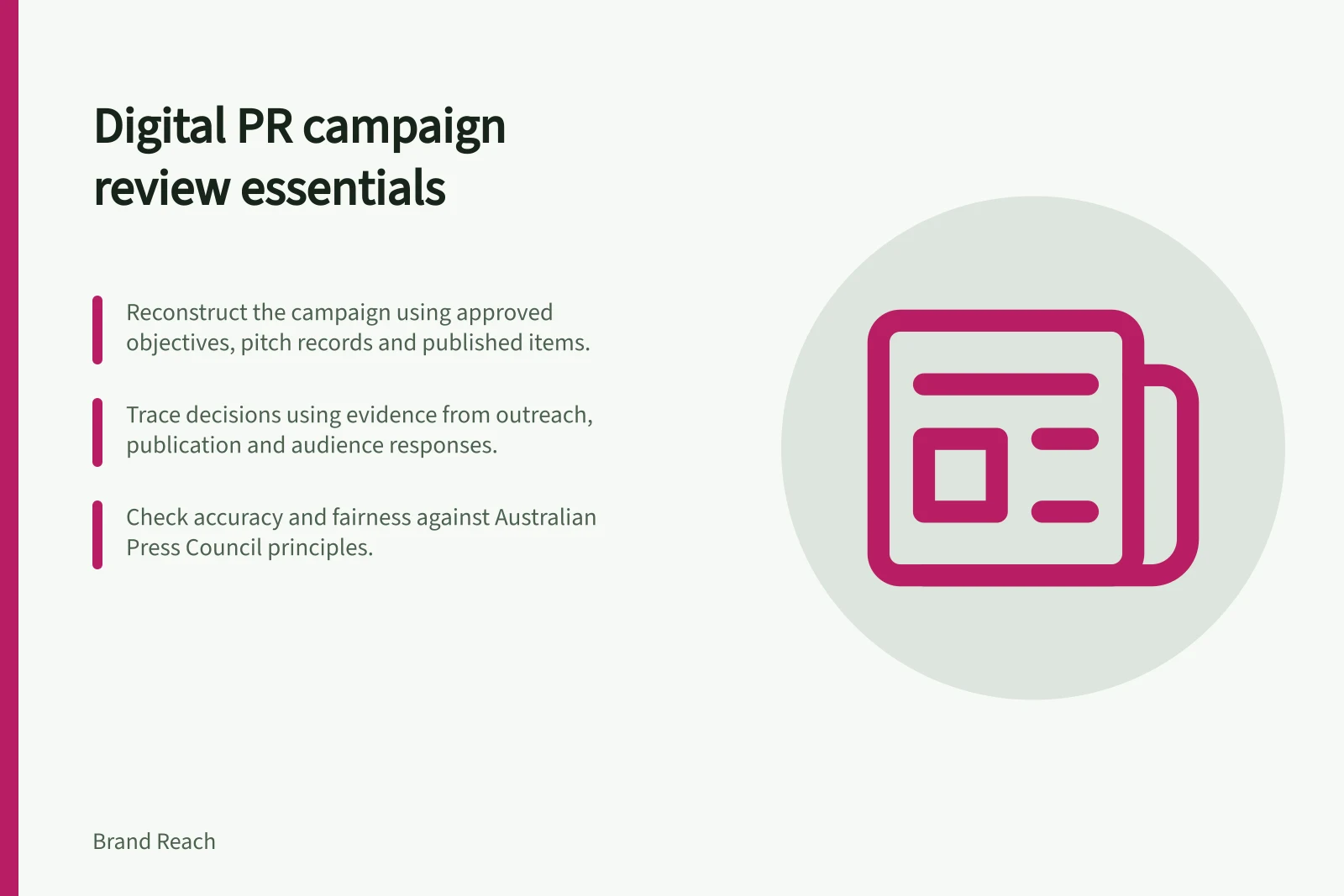
Review a digital PR campaign against its brief, outreach, editorial response, published coverage and observable audience response.
Review a completed digital PR campaign against its original brief: what was proposed, sent, requested, published and observed afterwards. Then record what the next campaign should keep or change. A coverage total alone cannot explain that decision.
Reconstruct the campaign
Bring together the approved objective, intended audience, story and research versions, pitch variants, send records, replies and published items. Set the review period and identify work still in progress. A request for information that remains open is not a declined story; a scheduled pitch is not a sent one.
Write the original objective beside the evidence available to assess it. If the aim was to help an audience understand a finding, inspect whether coverage explained that finding and its main limit.
Trace the decisions
| Review point | Evidence to inspect | Decision it can inform |
|---|---|---|
| Proposed angles | Approved wording, evidence and intended reader question | Which proposition was worth developing? |
| Outreach | Pitch versions, recipients, dates and replies | Where did a proposition meet an editorial question? |
| Publication | Live items and what they conveyed | Did the supported point appear in context? |
| Response | Enquiries, questions or audience research, where collected | What remains worth explaining or investigating? |
State the counting rule before comparing angles or periods. One journalist may receive several versions; one article may appear on several pages; one request for a table may produce no story. Mark missing send records and inaccessible pages instead of filling the gaps with assumptions.
Before vs After: Campaign Review Criteria
- Proposed Angles
- Approved wording, evidence, and intended reader question
- Outreach
- Pitch versions, recipients, dates, and replies
- Publication
- Live items and what they conveyed
- Response
- Enquiries, questions, or audience research (where collected)
Separate observation from interpretation
Read each substantive published item. Record whether it carried the central fact, identified the measured group and retained the qualification that changes the finding’s meaning. A positive mention can misstate a study; an article that challenges the preferred angle can still explain it usefully.
The campaign team should also check the accuracy of material it supplied.
Treat a journalist’s explicit request or stated reason for declining as an observation. Silence means only that no reply is recorded. A pattern of non-response may prompt a check of audience fit, timing or evidence, but it cannot establish an individual journalist’s motive.
Compare results with the brief at the level the data permits. An enquiry recorded after publication may be relevant; timing alone does not show that coverage caused it. Where no suitable audience measure was collected, report the publication evidence and identify the unanswered outcome question.
Check publication accuracy and fairness
For publications under its jurisdiction, the Australian Press Council’s principles require reasonable steps to ensure factual material is accurate, not misleading and distinguishable from opinion. They also call for a correction or other adequate remedial action if published material is significantly inaccurate or misleading. Note any such issue separately from whether the campaign achieved its objective.
The Council’s principles also address fairness and balance, including key facts whose omission could make factual material unfair. Where material refers adversely to a person, a fair opportunity to reply should be given if reasonably necessary. In the review, record whether a concern arose in coverage or in the material supplied, and decide what follow-up is warranted without treating the two as the same issue.
Carry the review into the next campaign
AMEC says its Integrated Evaluation Framework can be used retrospectively, but its value also comes from planning activity in advance and referring to the framework as activity develops. In a campaign review, use that cycle to connect retrospective findings with planning for the next brief.
If the review identifies evidence that was unavailable, record the gap and who can provide it before the next campaign begins. AMEC notes that considering required metrics at the outset can help teams ask the right people or source the necessary data before launch. Keep this as a decision about what the next review will need, not as a claim that the missing outcome was achieved.
Benefits and Risks of Using AMEC Framework in Reviews
- ProsEnables retrospective evaluation and proactive planning; aligns metrics with objectives; improves data readiness.
- ConsRequires upfront commitment to data collection; may not capture qualitative audience sentiment without additional research.
Record the next decision
Close with what to keep, change or stop, and what needs separate investigation. Assign an owner and a check that could show whether the change helped.
If several journalists requested the denominator behind a finding, for example, make that calculation and its limitations ready before further outreach. Do not assume every recipient wanted the same story.
For angle comparisons, use the same counting rule and review period. Record explicit declines as evidence of the reasons stated, not as proof of what all journalists prefer.
Assess a research asset’s continuing value against the original objective and available evidence; log any proposed follow-up study as a separate decision with an owner and a question to resolve.
AMEC describes its framework as both a planning and measurement tool, with outcomes as a key driver of planning. Use the review record to show how each proposed change relates to the original objective, and distinguish a decision supported by campaign evidence from one that still needs testing.
In this guide
- Comparing pitched angles with actual editorial interestCompare pitch versions with recorded journalist questions, declines and coverage without treating silence as interest or rejection.
- Reviewing why journalists declined a storyUse stated reasons for a declined PR story to check evidence, audience fit and timing while keeping guesses separate from replies.
- Measuring the useful life of a research assetReview a PR research asset’s use, reader relevance and evidence currency to decide whether to maintain, update, archive or correct it.
- Planning a follow-up study from genuine unanswered questionsTurn documented questions from a PR campaign into a follow-up research decision with a defined population, method and claim boundary.