Campaign Reviews
Part of Digital PR built on earned coverage
Defining a PR outcome beyond counting mentions
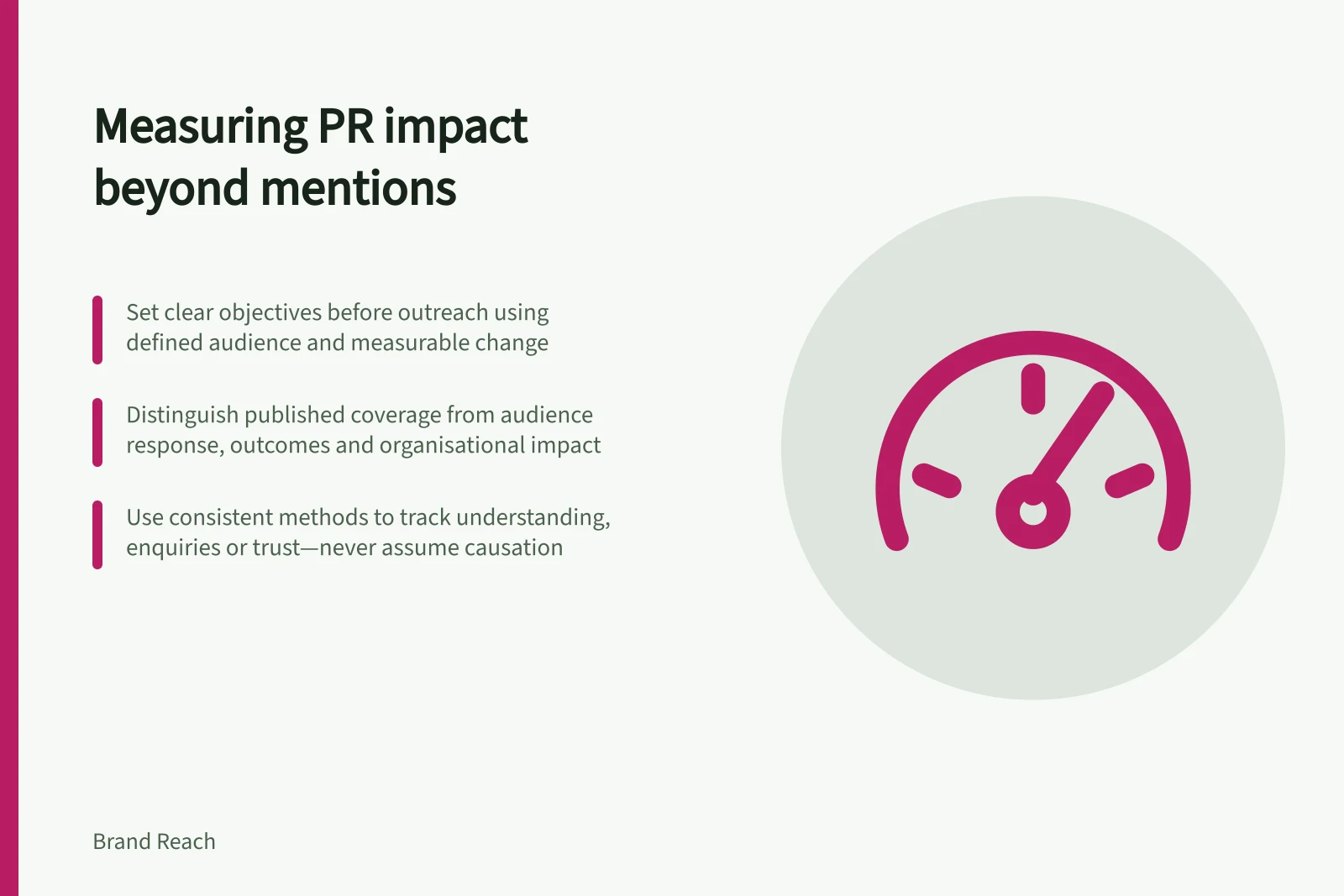
Set a PR objective for a defined audience, then distinguish coverage outputs from audience responses, outcomes and broader impact.
Name the change you want to see in a defined audience and the evidence that could show it. A mention count shows that coverage appeared. On its own, it cannot show whether the intended people noticed, understood, trusted or acted on it.
Set the objective before outreach. Then distinguish the published output from the audience’s initial response, a possible outcome and any broader organisational impact.
State the audience change
Start with the communication problem. Perhaps people affected by a service change cannot find a clear explanation, or a professional audience lacks confidence in a new process. Specify the group and what it should understand, believe or be able to do after the work.
An objective could read: ‘By [review date], [defined audience] will show [specified change], assessed using [method].’ These brackets represent decisions to make before a campaign, not results. Record a baseline where the method allows one and choose a review period that could reasonably show the change.
Keep the objective within what communication can plausibly influence. An article cannot be assumed to cause a sale, and an increase in enquiries may have several causes.
How to Define a PR Outcome Beyond Mention Counts
- Identify the communication problemDefine the issue—e.g., confusion about a service change or lack of confidence in a new process.
- Specify the target audienceName the group affected and what they should understand, believe or be able to do.
- Set a measurable objectiveUse format: ‘By [review date], [audience] will show [change], assessed using [method].’
- Establish a baselineRecord current state where possible to measure progress.
- Choose a realistic review periodEnsure time frame allows for plausible change without overclaiming.
Do not confuse the stages
| What you observe | What it may show | What it cannot establish alone |
|---|---|---|
| Published coverage | An output: where and how the subject appeared. | That the intended audience saw or understood it. |
| Attention, questions or reported understanding | An initial audience response, sometimes called an outtake. | A lasting change in attitude or behaviour, or sole causation by PR. |
| Measured change in trust, preference or intention | A potential audience outcome in the group measured. | That the change applies beyond that group or was caused only by PR. |
| A later organisational result | Possible broader impact. | PR’s share of that result without further analysis. |
Evaluation can distinguish published outputs from audience responses, outcomes and broader impact. These distinctions help prevent a publication count from being presented as an audience effect. Not every campaign can show every stage; short review periods may be particularly poor at showing impact.
Distinguishing PR Stages: Outputs vs. Outcomes vs. Impact
- What you observePublished coverage
- What it may showAn output: where and how the subject appeared.
- What it cannot establish aloneThat the intended audience saw or understood it.
- What you observeAttention, questions or reported understanding
- What it may showAn initial audience response, sometimes called an outtake.
- What it cannot establish aloneA lasting change in attitude or behaviour, or sole causation by PR.
- What you observeMeasured change in trust, preference or intention
- What it may showA potential audience outcome in the group measured.
- What it cannot establish aloneThat the change applies beyond that group or was caused only by PR.
- What you observeA later organisational result
- What it may showPossible broader impact.
- What it cannot establish alonePR’s share of that result without further analysis.
Decide how to check it
For each objective, name the audience, the signal, where it will be recorded, who will review it and when.
If understanding matters, decide how to ask the intended audience. If useful enquiries matter, define ‘useful’ and record them consistently. If coverage is the only reliable observation, report it as an output and say that audience effects remain unmeasured.
Inspect the published item too. Did it include the important fact and its limit? Was the context useful to the intended reader? Those checks improve a coverage record, though they do not prove an audience effect.
At review time, compare the observation with the objective and baseline. Note other activity or events that could explain a change. Say ‘we observed a change during the campaign’ unless the method supports a stronger causal conclusion.
Mentions remain worth recording. A defined audience change tells you what the communication was meant to achieve and what evidence is still missing.
Key Actions to Verify PR Effectiveness
- Define the audience clearlyWho are you trying to influence?
- Specify the signal of successIs it understanding, enquiries, trust, or another metric?
- Record data consistentlyUse predefined criteria (e.g., define 'useful' enquiry).
- Inspect published contentCheck if key facts and context were included.
- Compare with baselineAssess changes against pre-campaign conditions.
- Consider external factorsNote other events or campaigns that may have influenced results.
- Avoid overclaiming causalitySay ‘we observed a change during the campaign’ unless evidence supports stronger claims.