Campaign Reviews
Digital PR and link quality
Assess digital PR links by publication route, reader relevance, destination and paid-link treatment, without treating link counts as proof of value.
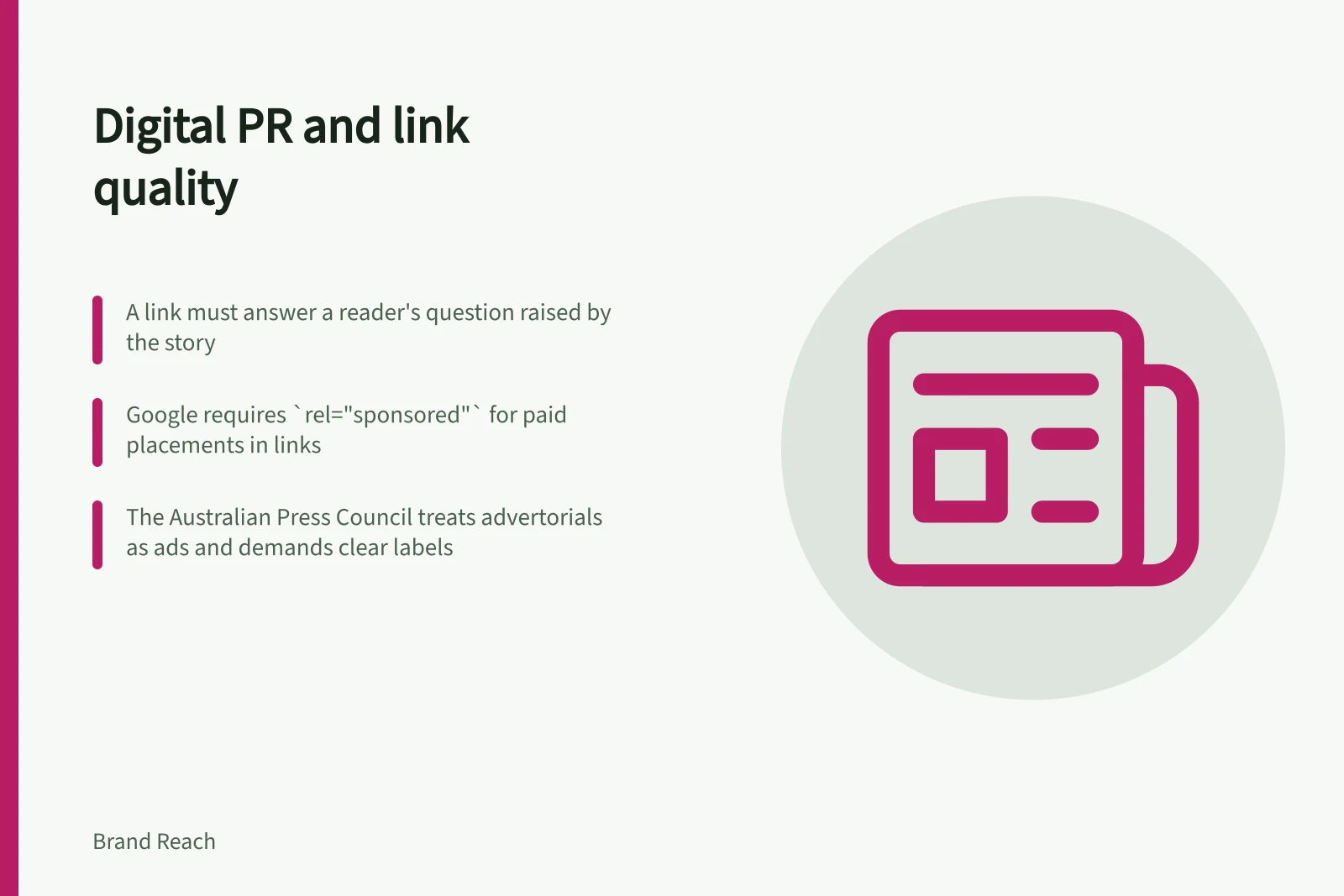
A useful digital PR link takes a reader to information that belongs with the published story. Ask why the item appeared, whether the linked page answers a question the passage raises, and whether a commercial arrangement affects the link. A link count alone proves neither quality nor a search benefit.
Start with the publication decision
An editor may use a finding and link to its source, use it without a link, or decline it. None of those outcomes is owed to the organisation that supplied the material. Paying a PR adviser to prepare research does not make a publisher's separate editorial decision a paid placement.
A sponsored article follows a commercial arrangement. Establish that arrangement before describing its links as editorial. Google's spam policies describe spam as techniques used to deceive users or to manipulate its Search systems into featuring content prominently.
The Australian Press Council’s advertorial guidance applies to newspaper and magazine content. It treats advertorials as advertisements and says complaints about them will usually be redirected to a relevant advertising or trade practices authority. Complaints about material outside a commercial arrangement may be considered under the Council’s Standards of Practice if its provenance is alleged to mislead readers.
Editorial link quality assessment checklist
- Publication routeWas the item independently chosen or commercially arranged?
- Reader fitWould this audience have a reason to use the destination?
- Passage and destinationDoes the linked page support the point made here?
- Link treatmentIf the link was paid for, is it qualified for Google Search?
Advertorial vs. editorial content: key differences
- Australian Press Council guidanceAdvertorials are treated as advertisements; require clear labelling such as 'advertisement', 'sponsored feature'.
- Google spam policiesSpam includes techniques to deceive users or manipulate search rankings; paid links must be properly tagged.
- Link qualification`rel="sponsored"` required for paid placements; `nofollow` used when no other rel applies.
Judge the link in context
Read the passage around the link. What would a reader expect to find after clicking? A link from a report on a study to the relevant finding or method helps readers inspect the evidence. A link to a broad sales page may not answer that question.
Open the destination. Check that it contains the information the passage points to and remains accessible. For a research claim, the relevant population, period, method and limitations should be findable there. A moved page or unrelated redirect weakens the connection even if the publication is relevant. These are editorial checks, not a ranking formula.
Google recommends descriptive link text that informs users and Google about the content of the linked page. Where an image acts as the link, Google uses the image's alt attribute as the link text. A publisher may choose its own wording; a brand's preferred keyword phrase is not a condition for an editorial link.
| Check | Question |
|---|---|
| Publication route | Was the item independently chosen or commercially arranged? |
| Reader fit | Would this audience have a reason to use the destination? |
| Passage and destination | Does the linked page support the point made here? |
| Link treatment | If the link was paid for, is it qualified for Google Search? |
An outlet's size or a third-party authority score cannot replace reading the item. A relevant link also does not prove that readers clicked it or that rankings changed.
Key metrics for evaluating digital PR links
- Link relevanceMust align with passage context and reader expectations.
- Page accessibilityDestination must remain accessible and not redirect to unrelated content.
- Editorial independenceNo obligation for publishers to include links even if research is paid for.
Read link treatment alongside the arrangement
For newspaper and magazine content, the Australian Press Council describes an advertorial as content that looks editorial but is published under a commercial arrangement. That arrangement may involve payment for an article, or an undertaking to publish editorial content in exchange for an advertisement or sponsorship. The Council says labels such as “advertisement”, “advertising feature”, “special feature” and “sponsored feature” should make the commercial nature clear to readers.
Google recommends using rel="sponsored" for links that are advertisements or paid placements, and more than one rel value may be used on a link. nofollow is for cases where the other values do not apply and the publisher would rather Google not associate with or crawl the linked page. Links with these values are generally not followed, although Google may find the destination through other means.
For Google to crawl a link reliably, it generally needs an HTML anchor element. That element must have an href attribute resolving to a web address.
Google says its spam policies apply across Google web search results, including results from Google's own properties. It uses automated systems and, when needed, human review to detect violations; sites may rank lower or disappear from results.
Choose the appropriate response
If original research is cited accurately but readers cannot readily find it, a brief request for a link to the exact public source may help. The publisher decides whether to add one and how to word it. A missing link is not automatically a factual error.
Do not make a link a condition of research participation. Accurate attribution can be encouraged without demanding a ranking-passing link.
For a paid placement, agree the treatment before booking and check the published link. Google recommends rel="sponsored" for paid placements. Regular links need no rel qualification; use nofollow when other values do not apply and you would rather Google not associate with or crawl the linked page.
This technical qualification is separate from identifying the commercial arrangement to readers. The Australian Press Council's advertorial guidance calls for clear identification within its stated newspaper and magazine scope.
Keep the page address, date checked, relevant passage, destination and known publication arrangement with each assessment. If the arrangement is unknown, mark it unresolved. Reopen the publisher page before reporting a link's current state.
Steps to assess a digital PR link
- Review publication routeDetermine if the content was independently selected or part of a commercial arrangement.
- Evaluate reader relevanceAssess whether the destination serves the audience’s likely intent.
- Verify destination contentConfirm that the linked page contains relevant findings, methods, and limitations.
- Check technical taggingEnsure `rel="sponsored"` is used for paid links; use `nofollow` where appropriate.
In this guide
- Evaluating a link by editorial relevanceCheck a digital PR link's surrounding passage, reader need, destination and publication route before calling it editorially relevant.
- Asking for a source link when original research is citedAsk for a link to a cited study with a precise, reader-focused note while respecting the publication's editorial decision.
- Avoiding mandatory links in research participation rulesWrite research participation rules that preserve accurate attribution without demanding backlinks or prescribed anchor text.
- Keeping paid sponsorship links correctly qualifiedSpecify and verify sponsored or nofollow treatment on paid publisher links, alongside clear reader-facing sponsorship identification.