Media Angles
Measuring digital PR
Plan digital PR measurement across published coverage, audience response and useful enquiries without overstating what the evidence proves.
Measure digital PR against the response it was meant to support. Record what appeared, assess whether it served the intended audience and examine any observable response. Coverage is evidence of publication only; it does not prove that readers understood the message or acted because of it.
Set the brief before outreach
Name the audience, the point they should understand, the useful response and the review period. Choose measures the team can collect. Record a baseline where the measure allows one, and note other activity that may affect the result, such as advertising or a service announcement.
The brief determines what to measure. Do not assume PR alone will cause a later change.
Label each kind of evidence
| Stage | What you might record | What it cannot establish alone |
|---|---|---|
| Output | Published items, their wording and placement. | That the intended audience noticed them. |
| Initial audience response | Visits, questions or feedback where observable. | A lasting change or sole causation by PR. |
| Audience outcome | A measured change in understanding, preference or intended action in the group assessed. | That the change applies beyond that group or was caused only by PR. |
| Wider impact | A relevant organisational or other later result. | PR’s share of the result without further analysis. |
A short review may leave later effects unmeasured.
Keep a checkable coverage record
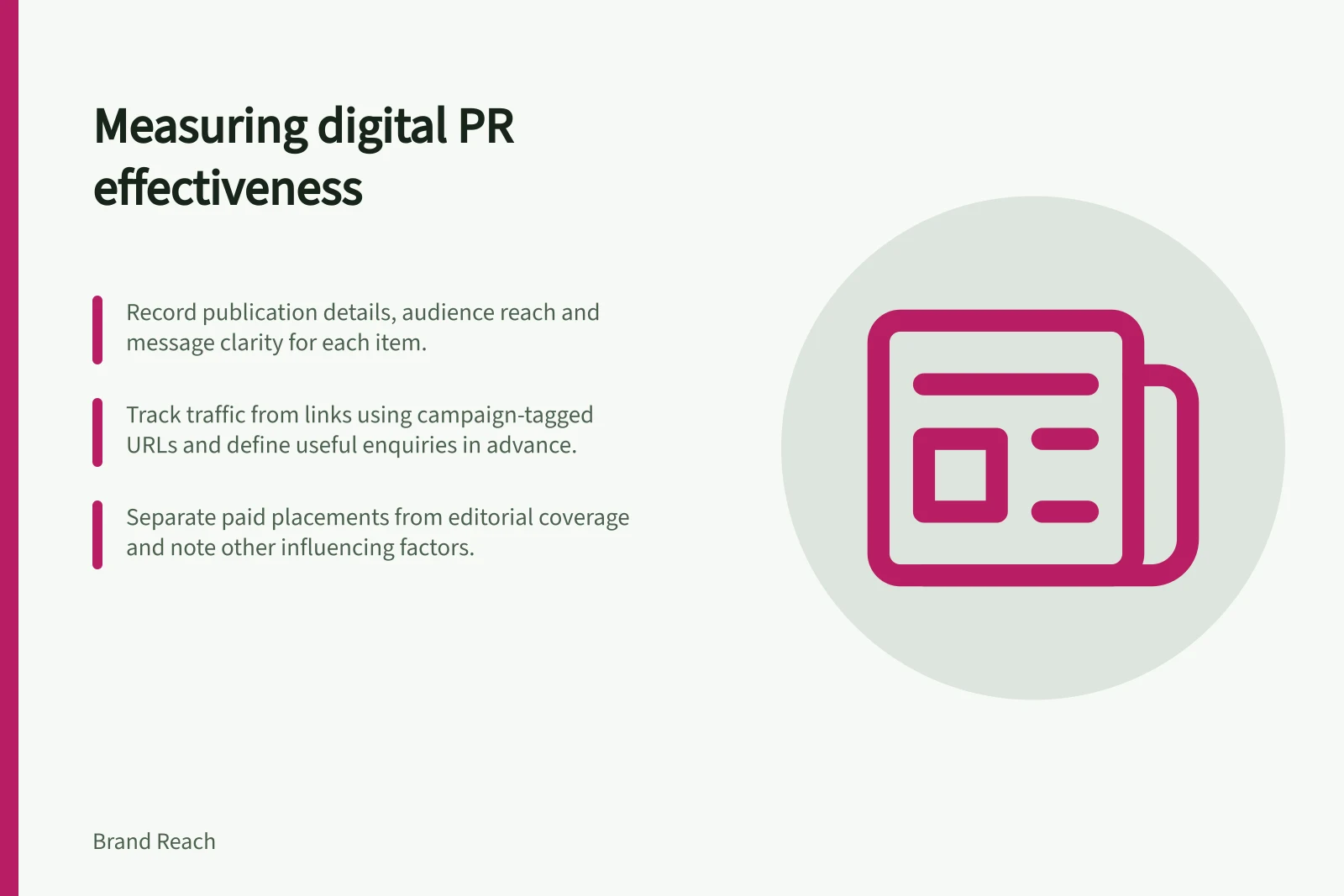
For each item, record its address, publication date, outlet, format, intended audience and the point it conveyed. Note whether an important qualification survived. State whether the counting unit is an original editorial item, each publisher page or another defined unit; identify syndicated copies, brief mentions and paid placements separately.
A mention total describes volume under that rule; it does not show whether a useful explanation reached the right context. A publication’s overall audience figure is not a count of readers of one item. If you use an audience estimate, identify its source, unit and uncertainty.
Check whether a placement was published under a commercial arrangement; appearance alone does not make it editorial coverage. The Australian Press Council says advertorials should be identified with labels such as “advertisement”, “advertising feature” or “sponsored feature”; it regards them as advertisements. Record that label and keep the placement distinct when reporting coverage.
Examine response within the available data
If an item links to your site, review the relevant dates, traffic source and landing page in the analytics data available to you. A campaign-tagged URL may help identify traffic through a published link when tracking is configured.
These reports do not capture everyone who read a story. People may search later, arrive directly or never visit the site. Referral information may also be missing.
Describe recorded activity as attributed sessions, not as a count of all readers influenced by coverage. Define a useful enquiry in advance and check actual requests against that rule; a web event alone does not establish their quality.
Digital PR Measurement Best Practices: Key Data Sources
- Google Analytics - Campaign Tagging for LinksHelps identify traffic from published links when tracking is configured.
- Google Analytics - Referral Data LimitationsDoes not capture all readers; some arrive directly or search later.
- Web Event QualityA single web event does not confirm quality; define useful enquiry in advance.
Report a decision and its limits
Present the objective, period, counting rules, representative coverage, observed response and missing evidence together. Separate independently selected coverage from paid distribution. Note other plausible influences before interpreting any change in traffic or enquiries.
End with the decision the record supports: keep the audience and message, clarify a point readers misunderstood, improve measurement or reconsider where the story was offered.
In this guide
- Relevant coverage versus raw mention countsCount digital PR items consistently and assess whether each conveyed a useful point to the intended audience.
- Tracking referred readers and useful enquiriesReview PR referral traffic and qualify enquiries while accounting for GA4 setup and attribution limits.
- Separating earned links from paid distributionClassify earned editorial coverage and paid distribution, then record their links without overstating endorsement or search value.