Pitching
Part of Measuring digital PR
Separating earned links from paid distribution
Classify earned editorial coverage and paid distribution, then record their links without overstating endorsement or search value.
Classify how each item was published, then record whether it contains a link. An independently chosen editorial article may link to a business, mention it without linking or decline the story. A paid distribution package may contain links, but payment does not make them earned editorial endorsements.
Establish the publication route
For each item, record who decided it would appear and whether publication formed part of a payment, sponsorship, exchange or distribution agreement. Check the agreement or publisher description where available, then inspect the live item. A label and page design can give clues, but the arrangement determines whether publication was bought.
Paying a PR adviser to prepare material does not by itself turn a newsroom's independent decision into a paid placement. Conversely, a publisher item booked under a commercial agreement remains paid even if it reads like a news article.
The Australian Press Council's advertorial guidance describes newspaper and magazine content published under a commercial arrangement and calls for identification that keeps readers from mistaking it for independent editorial content.
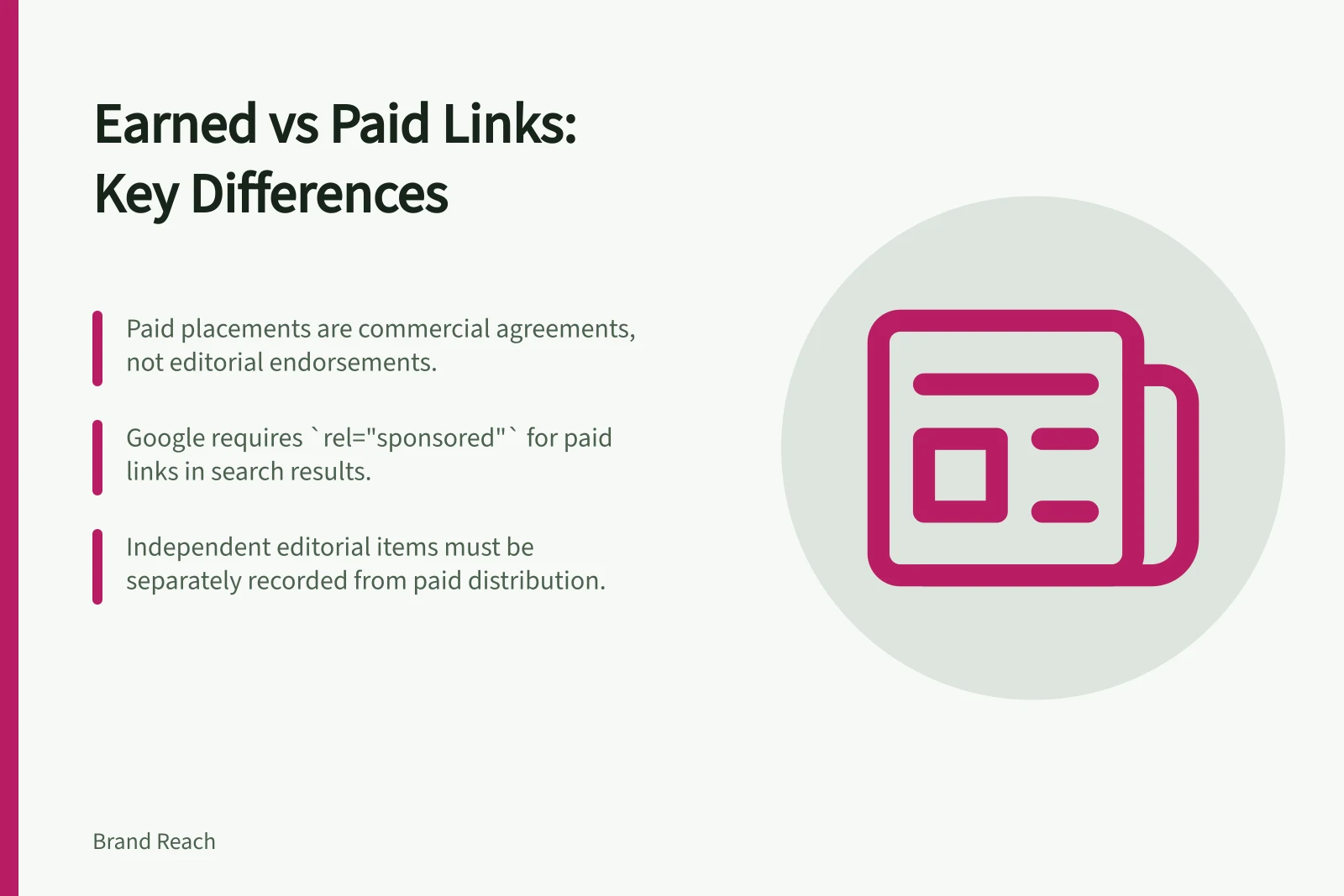
Earned Links vs Paid Distribution: Key Differences
- Publication Route
- Independently selected editorial (earned) vs. paid/sponsored agreement (paid)
- Editorial Control
- Newsroom decision-making (earned) vs. commercial arrangement (paid)
- Link Treatment
- No `rel` tag or `rel="nofollow"` (earned) vs. `rel="sponsored"` (paid)
- Reader Perception
- Independent news story (earned) vs. advertorial or sponsored content (paid)
Record placement and link separately
Field / What to record
- Publication route
- Independently selected editorial, paid or sponsored, or unresolved.
- Published item
- Outlet, date and what readers can see.
- Link
- Source page, destination, context and whether the link is live.
- Link treatment
- Any
relvalue found on the live link. - Response
- Attributed visits or enquiries, if available.
A mention is not a link, and a link does not establish editorial independence. If the arrangement is unclear, keep the route unresolved rather than including the item in an earned total.
How to Classify a Link Placement
- Determine publication routeWas it independently selected, paid/sponsored, or unresolved?
- Verify live itemCheck the actual page for labels, design cues, and link presence
- Record link detailsSource URL, destination, context, and whether the link is live
- Note `rel` attributeLook for `rel="sponsored"` or `rel="nofollow"` on paid links
- Do not assume endorsementA link does not equal editorial approval or search value
Check paid links within Google’s rules
Google Search guidance says links in advertisements and paid placements should use rel="sponsored"; it also accepts nofollow. These rules concern Google Search treatment of links. They do not predict the traffic or ranking effect of a particular placement.
For a paid item, check the live link and raise a mismatch with the publisher. Verify the current page before reporting a link's status.
Google Search Guidelines for Paid Links
- Required `rel` attribute
- sponsored
- Acceptable alternative
- nofollow
- Purpose of tagging
- To inform Google Search about paid link status
- Does not affect traffic or ranking
- Tagging does not guarantee SEO benefit or visitor increase
Reconcile the report
Show independently selected editorial items and paid placements separately, using a stated counting rule for each. If a paid release and a later independently reported article cover the same finding, record their different publication routes.
Do not assume the release caused the later editorial decision without evidence. The report should show what appeared and how, without turning a link count into a claim of endorsement or search value.